
News · History
Before it was Grantville, it was Calico Corner. Meet the railroad engineer the town is named for.
The Atlanta and LaGrange Railroad reached the crossroads in 1852, and the town took the name of its chief engineer, Lemuel P. Grant. Here is who he was and what the railroad built. First in a Ledger history series.
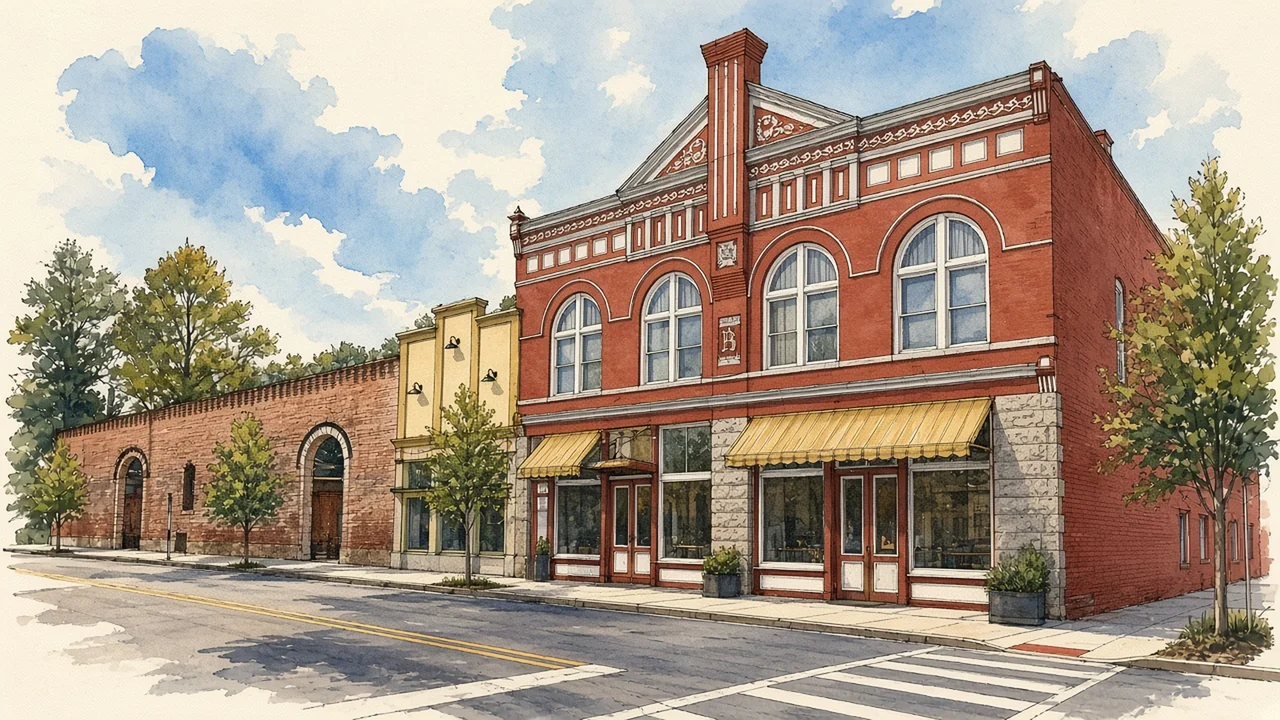
Before there was a Grantville, there was a crossroads called Calico Corner. It had homes, a few small shops, a school and a church, according to the city’s 2022 downtown plan. Then, in 1852, the railroad came, and the town got a new name.
“In honor of L. P. Grant, chief engineer of the railroad, the name of Calico Corner was changed to Grantville,” says the 1991 nomination that put the Grantville Historic District on the National Register of Historic Places. The Atlanta and LaGrange Railroad had been organized in the 1840s, the nomination says, and its first train reached the town in 1852. The line later became the Atlanta and West Point Railroad.
Who was L. P. Grant?
Lemuel Pratt Grant was born in 1817 in Frankfort, Maine, and came to the Atlanta area in 1849 to survey the Atlanta and LaGrange line, according to the New Georgia Encyclopedia. He went on to incorporate other railroads and served as superintendent of the Atlanta and West Point. The National Register nomination says he became the line’s president.
During the Civil War, Grant was chief engineer of the Confederate Department of Georgia and designed the fortifications around Atlanta. The encyclopedia records that he issued orders to hire enslaved laborers from their owners, at $25 a month, to build them.
After the war he built Atlanta’s Market (Broad) Street bridge, served on Atlanta’s city council and the Fulton County commission, and was a water commissioner and a member of the city board of education. In 1882 he donated 100 acres for Atlanta’s first public park, now Grant Park. He died in 1893.
The Ledger found no record that Grant lived in the town that carries his name. The National Register nomination lists no single founder. It describes a town built by the railroad and by the merchants, mill owners and farm families who followed it.
What the railroad built
The nomination, drawing on a 1989 survey and the Newnan-Coweta Historical Society’s 1988 county history, sketches the town that grew around the tracks:
- The first big store. W. J. Garrett of Atlanta and T. E. Zellars of Grantville opened a store in 1865. In 1877 they built a two-story brick store selling dry goods, meal, grain and groceries, with furniture, stoves, wagon parts and caskets upstairs. The second floor later held the telephone exchange.
- Schools and culture. Grantville had a high school as early as the 1860s, and families moved to town for it. A literary and musical club organized in 1887.
- A hotel for the railroad. Sewell and Bevis built the Grantville Hotel in 1881. When it burned, the Hotel Exchange replaced it in 1898.
- Uptown and downtown. N. O. Banks and Glenn Arnold built the Banks and Arnold store in 1893, selling dry goods, groceries and caskets. In the late 1800s, the town had about 650 people, eight businesses, a hotel, a grist mill, a sawmill, two blacksmiths, four churches, three schools, two lawyers and three doctors.
- The mills. Banks founded the Grantville Hosiery Mill around 1895. It grew into Grantville Mills, which sold yarn nationwide and made men’s work socks and women’s cotton hosiery.
By 1900 the population was 769. A 1906 state guide described express and telegraph offices, a bank, two grist mills, a public ginnery (cotton gin) and a hosiery mill employing 50. The Grantville Bank was chartered in 1901. Eight northbound and eight southbound trains passed through each day, and a train known as the “Goober” carried passengers to Newnan and Atlanta. In 1912 the Newnan Herald called Grantville a “progressive, busy little city.”
When cotton failed
In the late 1920s and 1930s, the boll weevil devastated Georgia’s cotton fields. Around Grantville, the nomination says, cotton production “virtually ceased” and was replaced by beef cattle and dairying, and Colley Farms added fruit and nut orchards. Better county roads and cars drew people away; the Goober excursion to Atlanta ended in 1929 for lack of riders. Small cotton farmers moved to cities or into Grantville to work in the mills. From the mid-1930s, the nomination says, the mill, the schools and the struggling business district were the main employers.
Next in this series
The Ledger is researching the town’s main businesses and grocery stores in the 20th century, and the history of Grantville’s Black families, including those who worked in the cotton fields. A 1953 Atlanta University thesis, “The Negro Community of Grantville, Georgia,” by James N. Shopshire, is one source we are working to obtain.
Did your family run a store, work at the mill or pick cotton around Grantville? We would like to hear your stories. Email tips@grantvilleledger.com.
Sources
- The National Register nomination cites a 1989 historic district information form by Sandra Parker and the Newnan-Coweta Historical Society’s History of Coweta County (1988). The 1906 and 1912 descriptions are as quoted in the nomination.
- National Park Service, National Register of Historic Places: Grantville Historic District nomination (NRIS 91000772, 1991), Section 8
- New Georgia Encyclopedia: Lemuel Grant (1817-1893), by Tammy H. Galloway
- City of Grantville: Livable Centers Initiative plan, draft final report (Oct. 17, 2022), history section
- Atlanta University Center: The Negro Community of Grantville, Georgia (James N. Shopshire, 1953), catalog record