
Know Your Grantville · History
Know Your Grantville: The land before Calico Corner
Before a railroad engineer gave Grantville its name, the settlement called Calico Corner grew up on land that was Muscogee (Creek) country until the 1825 Treaty of Indian Springs. A treaty, an execution, a spring and a $50 log cabin tell the story.
Long before the first train pulled into Grantville in 1852, and before the town took a railroad engineer’s name, this ground lay inside the Creek Nation. Coweta County’s own bicentennial history says so plainly. The county was founded in 1826 “as part of the Creek Nation,” it says, and among its early settlements was Calico Corner, the community that became Grantville.
Even the county’s name reaches back to that world. Coweta was named for the tribe headed by William McIntosh Jr., whom the county history describes as half-Scot and half-Creek. McIntosh, it says, “relinquished lands to the federal government in the 1825 Treaty of Indian Springs.”
A treaty, and an execution
The New Georgia Encyclopedia fills in the man. McIntosh, also known as Tustunnuggee Hutkee, was born around 1778 in the Lower Muscogee town of Coweta, to a Scottish father and a Muscogee mother of the Wind Clan named Senoya. He rose to become a controversial chief of the Lower Muscogee (Creek).
On Feb. 12, 1825, he signed the second of two Treaties of Indian Springs. It ceded virtually all of the Muscogee land that remained in Georgia. Only six chiefs signed it, McIntosh among them, and Muscogee law treated giving up land without the full assent of the nation as a capital offense. On April 30, 1825, McIntosh was killed at Lockchau Talofau, his home in what is now Carroll County.
His mother’s name is still on the map. The county’s bicentennial page says Senoia, first called Willow Dell, is named after her. The same page lists the county’s other early settlements: Bullsboro, Newnan, the county seat, established in 1828, and Calico Corner.
Homes around a courtyard
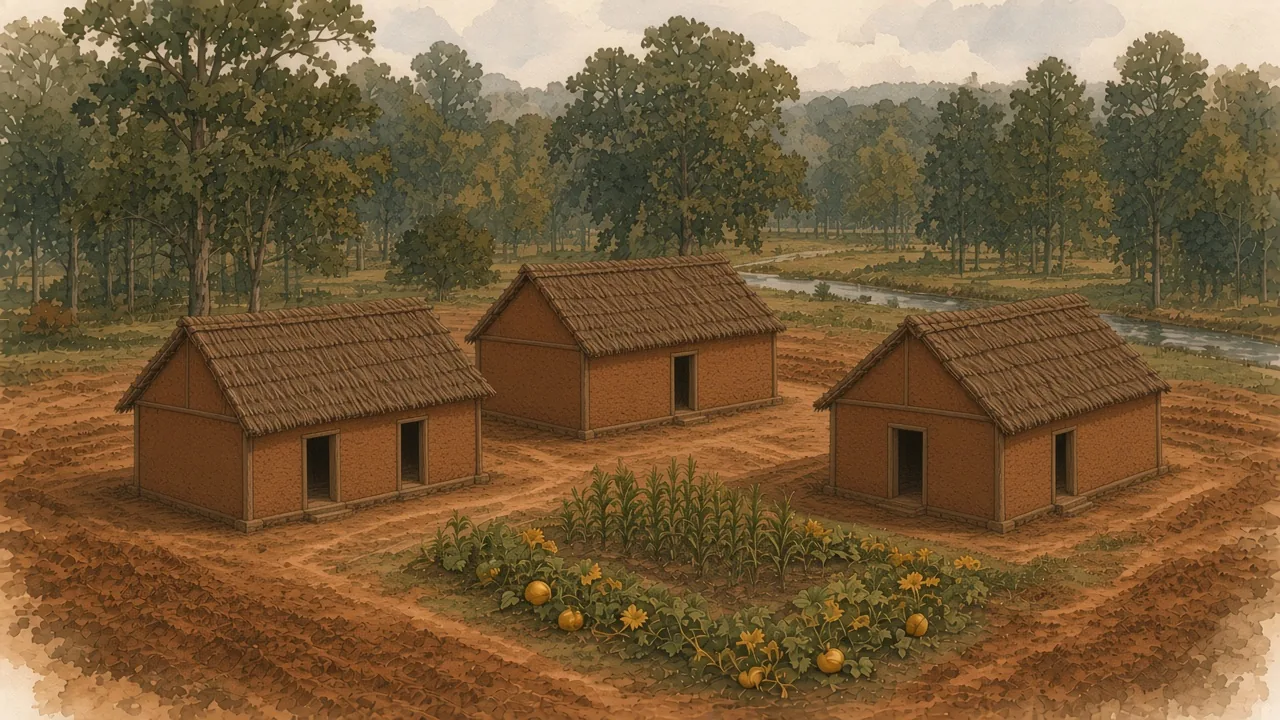
William Bartram, traveling through Creek country in the 1770s, described family households of up to four buildings arranged around a courtyard, a pattern the National Park Service still cites at Ocmulgee Mounds. Accounts drawing on Bartram and on Indian agent Benjamin Hawkins, at the end of the 1700s, describe houses built on wooden frames set in the ground, lathed with canes, plastered inside and out with clay, and roofed with bark or grass. By the turn of the nineteenth century, some families also built log houses. Each town gathered around a public square, the center of civic life. The illustration with this story is drawn from those descriptions.
A spring, and a cabin
Then came the settlers. A family history printed with a 1971 Newnan Times-Herald story, preserved in a USGenWeb Archives transcription, says Daniel Meadows was taking his family from Wilkes County to Texas when they stopped at a spring at the southern end of Coweta, near the place that would become Calico Corners. Daniel liked the water. The horses needed rest, and there was cane and honeysuckle for them to graze. The family stayed.
The Meadows Cabin stands in the Grantville Park Complex today, on the same grounds as the ball fields and the Grantville branch library. In 1971, with Interstate 85 coming through, Coweta County bought it for $50 and moved it to Grantville. A family marker beside it, photographed in 2005, read “Cabin built 1828.”
The railroad brought the rest. The National Register nomination for the Grantville Historic District records the first train in 1852, and Calico Corner was renamed for L.P. Grant, the railroad’s chief engineer. The Ledger told that chapter on Nov. 13.
The older chapter is still close at hand. Walk into the park and the Meadows family’s log cabin is waiting. Senoia, once Willow Dell, still carries the name of a Muscogee woman. And the county itself still carries the name Coweta, the Lower Muscogee town where McIntosh was born.
The Grantville Ledger is free, and it runs on readers. Tell us what you thought of this story at tips@grantvilleledger.com. If you enjoyed it, share it on Facebook and Instagram, and sign up for the free Ledger newsletter.
Sources
- Coweta County: Coweta County Bicentennial (county founded 1826 as part of the Creek Nation; named for the tribe headed by William McIntosh Jr.; 1825 Treaty of Indian Springs; early settlements including Calico Corner (Grantville), Willow Dell / Senoia, Bullsboro, and Newnan, established in 1828)
- National Park Service, Ocmulgee Mounds National Historical Park: People (Bartram on Muscogee households of up to four structures around a courtyard, and the town square as the center of civic life)
- William Bartram, Observations on the Creek and Cherokee Indians (written 1789; later published): Upper Creek dwellings as little squares of one to four houses enclosing a courtyard
- Encyclopedia of Alabama: Upper Creek Towns of the Historic Period (family compounds; wooden frames lathed with canes, plastered with clay, roofed with bark or grass; accounts of Bartram, Benjamin Hawkins and others)
- New Georgia Encyclopedia: William McIntosh (ca. 1778-1825), by Melissa Stock, University of West Georgia (originally published Oct. 12, 2007; last edited Feb. 18, 2026). Two Treaties of Indian Springs, 1821 and 1825; the 1825 treaty signed Feb. 12, 1825, by six chiefs including McIntosh; McIntosh executed April 30, 1825, at Lockchau Talofau.
- National Park Service, National Register of Historic Places: Grantville Historic District nomination (NRIS 91000772, 1991), Section 8 (first train 1852; Calico Corner renamed Grantville for L.P. Grant)
- The Grantville Ledger: Before it was Grantville, it was Calico Corner. Meet the railroad engineer the town is named for. (Nov. 13, 2026)
- The Grantville Ledger: Saved from I-85 for $50: the log cabin, and the love story, hiding in Grantville’s park (Ledger visit Nov. 11, 2026; 1971 Newnan Times-Herald accounts as transcribed in the USGenWeb Archives)